The Batley Cemetery Incidents: Part Two

Now, to understand the proper context behind this incident, I’d ensure you have read about the 1905 incident.

To start, we have to discuss an ending, more specifically the death of Mr. Joseph Brook. Prior to his passing, he resided at 38 Pyrah Street off Carlton Road in Dewsbury and was employed for many years at the woollen manufacturers Messrs. Mark Oldroyd and Sons Ltd. He married Emma Ellis in 1872, and they went to have five children that survived infancy, with at least three passing away in their childhoods. Out of the five surviving children, there were four girls and one boy.
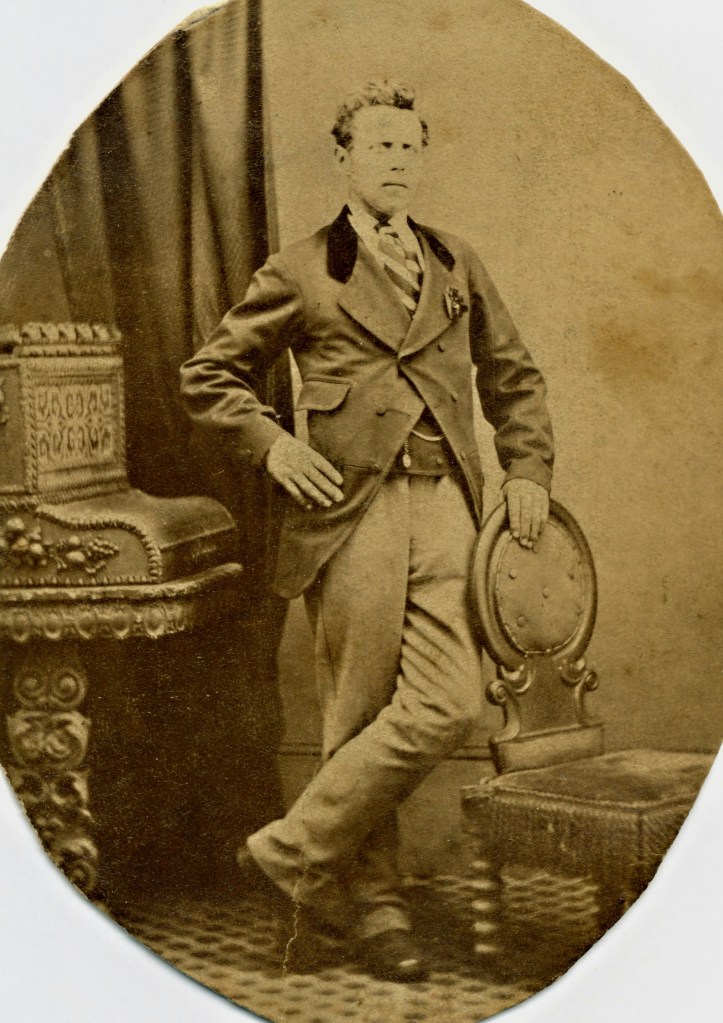
Joseph Brooke, photo uploaded onto Ancestry

However, his health began to decline in 1907, and he was unable to work regularly and passed away on 7 August 1907, aged 56 years. He was interred in a plot at Batley Cemetery with three of his deceased children three days later. The funeral was a large one, attended by more people than the Chapel could accommodate, and everything passed satisfactorily.

The day after Joseph’s funeral, alongside one of her daughters, Mrs. Brooke visited the cemetery. She wanted to ensure that the grave had been filled in and to have a look around and perhaps visit her husband.

In an almost familiar scene to that of Mr. Marsden’s visit in 1905, Mrs. Brooke instantly sensed something was wrong, remarking to her daughter that she was certain that her father was buried in the wrong grave. Again, a certain type of tile surrounded the grave, and Mrs. Brooke noted it was not disturbed.

Now convinced the error had been made, Mrs. Brooke was unsure what to do. Naturally, this deeply disturbed her, and she was unable to sleep at night. Not only had she lost her husband, the breadwinner, and had four children to look after, but she now had to sort out this error. Finally, about five or six days after the burial, after taking some advice, she decided that the best course of action would be to head to the cemetery lodge and talk to the Registrar, Mr. William Henry Atkinson.
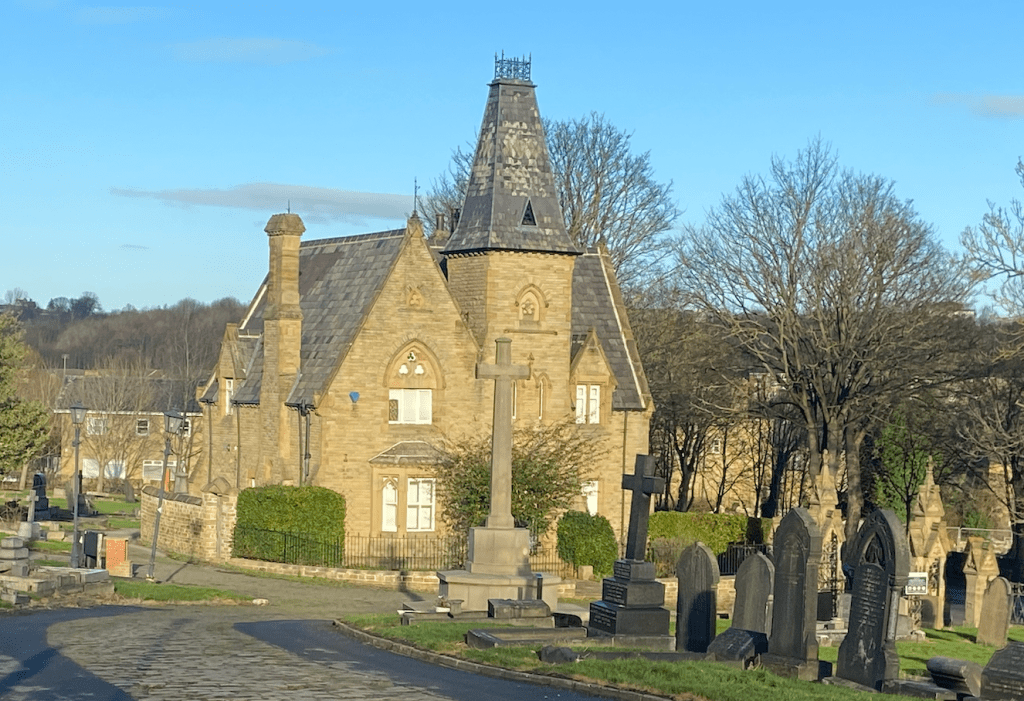
The Cemetery Lodge, taken on 5 Jan 2022 by George Hall

Atkinson didn’t believe her at first but was willing to check to ensure a mistake hadn’t been made. It quickly became apparent that Mrs. Brooke was correct in her assessment, and Mr. Brooke’s almost perfect funeral had one fatal flaw. He was buried in the wrong grave.

The Cemetery Registrar immediately expressed his deep regret to Mrs. Brooke and promised her the incident would be sorted. Afterwards, Mrs. Brooke communicated with a Town Council member and the Deputy Clerk of the Council, with the latter being contacted as the Town Clerk himself was away. She was even advised to contact the Mayor (Cllr. W. J. Ineson), who assured her that everything would be sorted in a satisfactory manner without a doubt.

This greatly comforted Mrs. Brooke but being a woman of incredible grit and steel, she refused to rest until her objective was met, continuing to contact the relevant bodies for the next week.

A short while passed, and it was reported that the Home Office had been contacted and that the official form required for the reinterment had been received. However, owing to the typical bureaucratic nature of government agencies, it took a while to arrive. Furthermore, it was reported that Mrs. Brooke and her family were satisfied that everything was being done to rectify the mistake.

Eventually, on 29 August 1907, the permit for the reinterment of Mr. Brooke was received in Batley. The following day at 6 am, Mr. Brooke was interred into the correct grave, finally resting with his three deceased children. Mrs Brooke, the driving force in ensuring the mistake was rectified, alongside three other family members and various representatives of the council and Atkinson, the Cemetery Registrar.

Emma Ellis, Mrs. Brooke in later days

The incident is a testament to the courage, determination and perseverance of Mrs. Brooke. After all that she had been through, she had managed to get it sorted. However, the incident also shows the impact of the 1905 incident as everything is done “above board” with no chance of any legal comeback.

With that comes the end of my interest in these two very unnecessary and unfortunate incidents in 1905 and 1907. Unfortunately, I know for a fact that incidents like this would continue up until at least the 1990s, if not the present day. I suppose this is a sad reality that we must face, but it seems so cruel that families have to face these incidents in times of grief.
The Batley Cemetery Incidents: Part One

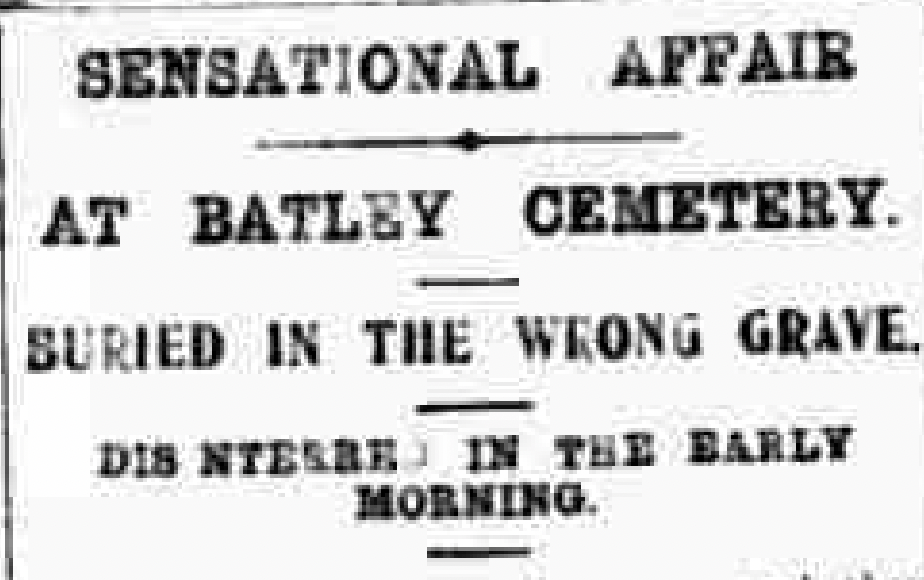
A sensational headline was recorded in the Batley Reporter and Guardian on 16 June 1905. But how did this incident happen and what was the true story behind it?

John Edward Marsden was an average bloke. Born around 1872 in Dewsbury, he married Rachel Emma Kelsell in 1895 and went on to have three children (Edith, Harry, Hilda) with her. Their eldest was a daughter named Edith, who was born on 27 February 1897. Sadly she passed away aged sixteen months and was buried in plot R 360 on 25 June 1905 at the Cemetery. Her father worked in the mill and could not mark the grave with a headstone, but a bottle was placed on the grave, containing a card with Edith’s name written on it. Furthermore, the grave was enclosed with some red tiles, and Mr. Marsden paid half a crown a year to help keep her plot in order.

The Marsden Plot (R 360) taken by George Hall on 5 Jan 2022

It is unclear precisely from who, but John Marsden heard that his daughter’s grave had been disturbed around May 1905. Obviously, after hearing the chatter, he went to check up on her grave. Much to his horror, he was able to confirm the grave had been disturbed almost immediately as the “little mound” upon the grave had grown by about a foot and also the soil on top of it appeared to be freshly broken. Additionally, the bottle containing the card was removed, and the tiles around the edge were scattered.

However, this was not the most worrying thing as the cut flowers that now upon the grave suggested there had been a fresh internment in it recently. Obviously, as the grave owner, Marsden knew that permission was not granted for the grave to be disturbed nor for a fresh interment, so he went to see Mr. William Henry Atkinson, the Batley Cemetery Registrar.

Atkinson was adamant that the grave hadn’t been disturbed at first and went into his office and checked his book. Marsden insisted that the grave had been disturbed, and Atkinson reviewed another book and consulted the grave plan. Both men then decided to check the grave together, where Atkinson hoped to convince Marsden that the grave hadn’t been touched.

Once at the grave, it was pretty obvious for the reasons said before that it had been disturbed, and Atkinson admitted that a mistake had been made but assured Marsden that the mistake would be “put right”.

The Twin Chapels located at Batley Cemetery in July 2021

Marsden called upon Atkinson a fortnight later, and he was told that the situation had been resolved. However, Marsden reasonably wished to receive some proof, and after some convincing, both men visited the grave, and Atkinson took a rod and bored it into the soil. He then said that it had gone to the bottom and, therefore, Mr. Marsden’s daughter was the only person interred in the grave. Mrs. Marsden visited the grave after it had been “put right” and noted that the cut flowers previously on her daughters grave had been moved to another grave nearby.

Mr. Atkinson was called upon for a statement by the Batley Reporter and Guardian. He explained that when a grave is opened for another interment, a rod is placed upon it in an upright position. Mr. Atkinson didn’t necessarily see the said graves until the interment took place but still was unsure exactly why or how Mr. Marsden’s plot was disturbed. Perhaps the rod had been placed incorrectly or moved by some unknown party from the intended plot to Marsden’s, which were situated close to each other. He also explained the fact that his daughter had been seriously ill around the time of the burial and was therefore not in his usual state of mind.

Nevertheless, Mr. Atkinson took responsibility for the mistake and ensured that the deceased was reinterred into the correct grave. However, Mr. Atkinson didn’t write to the Home Office to ask for permission to reopen the grave as was the law. Therefore in July 1905, the Cemetery Committee heard a letter addressed to the Mayor of Batley from the Secretary of State asking for his observations of the matter. A subcommittee was formed to discuss the matter after the Cemetery Committee met on 15 June 1905 and met on 16 June 1905.

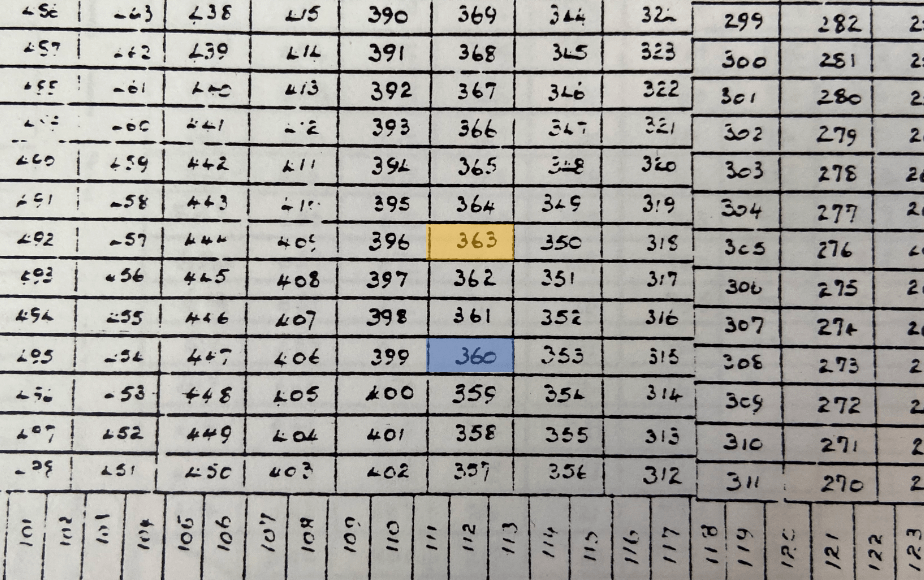
Now you may be asking, who was the person interred into the incorrect grave? Atkinson gave us a clue as he stated it was a woman but logically refused to provide a name. After looking at the Batley Cemetery burial register located at Batley Library, I believe that Mrs. Susan Regan, a 70-year-old widow, was incorrectly buried in the Marsden plot.

Blue = Marsden plot, Orange = Regan plot

She resided on Talbot Row, which was located on Bradford Road. She was meant to be buried in R 363, which is situated close to R 360, the Marsden plot. Furthermore, the burial date of 13 May 1905 allows Mr. Marsden to discover the issue, report it to Mr. Atkinson, and come back in two weeks time. After that, the excess time can account for gossip spreading, which the article (which obviously takes some time to produce) wished to quell. I cannot be 100% certain but there is a strong chance it is her.

Not much was reported in the Batley Borough Council minute books located at the wonderful Batley Library regarding the matter. The subcommittee which was formed isn’t mentioned. The only aspect mentioned is the Mayor’s reply to the aforementioned Secretary of State’s letter, which was approved. Either way, the Committee must have decided against taking any action against Mr. Atkinson as he remained in his post of the Cemetery Registrar.

No matter the reasoning behind the error, it clearly reinforces that everyone is imperfect and human error and chance can affect various fields. Mr. Atkinson shouldn’t be held entirely at fault and clearly took his duties seriously as registrar. However, you would expect lessons to be learnt and changes to be made.

Unfortunately, another familiar headline would be reported in a Batley newspaper a mere two years later.

John Thomas Crossley: A Difficult Life

John Thomas, the son of Joshua Joseph Crossley and Margaret Murphy, was born on 7 January 1866, on Bradford Road near Batley Carr. He was born into atypical circumstances as his father was already married with two children to a lady named Emma Parker. However, Joshua had probably left Emma before the birth of John as on his birth certificate, he is registered as Margaret’s son, who is in fact also recorded as Joshua’s wife.

The couple did marry eventually, around two years after the death of Emma, at Batley Parish Church on 11 July 1870. The couple already had another two children by the time of their marriage, Emma in 1869 and George in early 1870. Over the next decade or so, the couple would have three more children.

Batley Parish Church in July 2021

Just around sixteen months after the couple’s marriage, on 11 November 1871, Joshua was brought before Batley Borough Court to face charges of assaulting his wife. In the words of Margaret herself, on 18 November 1871, Joshua returned home drunk and struck her. The Huddersfield Daily Examiner reported that Margaret appeared in the witness box with a black eye which appeared greatly swollen. Margaret was reluctant to testify as she had agreed not to press charges as Joshua had promised but admitted that Joshua had struck her again since the original incident. It seemed that when Joshua was under the influence of liquor, he was in the habit of beating his wife. Joshua ended up pleading guilty, and the Mayor allowed Joshua to remain free but warned him that as these cases were becoming frequent, another case would see him sent to prison.

Times were hard for everyone, especially the working classes, and individuals may have found it hard to cope. Furthermore, individuals typically repeat the actions they were taught, so we must consider these and many more factors before condemning Joshua as an absolute villain. But being truthful, I find it hard to view him in anything but a negative manner. I appreciate the many factors that could cause it, but his apparent lack of respect for women is unjustifiable and plainly wrong, even if it was 150 years ago.

After an illness of a year or so, John Thomas Crossley’s father died of heart disease in August 1887. John remained living with his mother up until his marriage in 1893, and in this period before his wedding, the consequences of a difficult childhood became apparent.

John was either imprisoned for two weeks or fined for being drunk and disorderly in 1891. More convictions would follow in 1901, 1905 (this one was for obscene language) and 1913, with perhaps even more taking place. At least one or two convictions would end up in John being sent to prison for a week or two. It was said that John was a hardworking man but would leave his family penniless as he spent most of his money on alcohol.

He married Fanny Eliza Tasker at Birstall Parish Church on 11 December 1893. They went on to have two daughters, including Alice, my Great Great Grandmother, and three boys.

Alice Crossley, my Great Great Grandmother, during her youth

One of his sons, James Edward, was born in late June 1900. Around this period, it seems that John enlisted into the 3rd King’s Own Yorkshire Light Infantry’s Militia Battalion. He first tried to desert the battalion based in Strensall and succeeded for a while but was eventually arrested and detained and attached to an escort. However, he managed to break away again despite being handcuffed and concealed himself in a house in Birstall, the town where his family was living. Eventually, he was caught hiding under a bed in an upstairs room with the handcuffs from his original arrest in his pocket. He was sentenced to 85 days imprisonment, on 30 August 1900, for absence, breaking away from an escort and loss of kit.

Three of his children were living with their elderly maternal grandparents up Blackburn Road in Birstall by 1911. His daughter Frances was adopted out of the family by that point. Fanny Eliza, his wife, died in 1914, aged only 47 years.

John’s later years remain a little more mysterious. It is possible he remarried to a lady named Mary Frain in 1915, but from about 1924 to 1926, he lived with a relative without a wife registered to vote at that address. He appears on the 1939 Register, aged 73 years, as an old age pensioner living at some unknown establishment situated in Batley.

John Thomas Crossley’s 1939 Register entry

There is no clear record of his death, but it is likely he died in the 40s or, at a push, the early 50s.

John’s life was clearly a complex one. He may have simply been a victim of the times and also circumstances, struggling to cope in a harsh world and being affected by his father’s behaviour towards alcohol and his mother. This would, in turn, affect his own family, just like it affected him. However, he was also clearly a defiant character, willing to do things his own way, even breaking away from an army escort for unknown reasons.

Alfred Dale: The Man who Missed Out

Alfred Dale was born in November 1858, most likely at the family home situated on Dennis Street in Walmgate, York. He was the sixth child of William, a composite, and Mary Dale, formerly Stead. Mary undertook the typical but still gruelling domestic work while William Dale worked as a printer compositor, arranging a movable type for printing. It was a skilled profession, and William would have had to be skilled at spelling alongside probably needing a basic understanding of grammar and punctuation. In addition, he likely worked under high-pressure conditions with the machines moving at high speeds and mistakes being very costly.

Alfred was baptised on 30 November 1858 at St. Deny’s Church in Walmgate. In 1861 the family lived at Butter’s Buildings, remaining in the Walmgate area, and by 1871, the family moved to 2 Hope Street in the same area. All nine Dale siblings had been born, six boys and three girls by that point. In that year’s census, Alfred is described as a scholar and, at some point before his marriage, would take up work as a glassblower, perhaps following the footsteps of his older brother Edward.

St. Deny’s Church

Alfred married Mary Jane Fell towards the end of 1879. Mary Jane’s family was a challenge to wrap my head around, but due to an illegitimate birth a few generations before Mary Jane, the family seems to switch between “Turner Fell” and “Fell Turner” as their surnames. It seems to settle out as Fell towards the end of the 19th century.

The 1881 Census gives us a picture of life for the newlyweds; they were living at 14 Willow Street, again around the Walmgate of York. Interestingly, Mary Jane is recorded as working as a combmaker’s labourer, probably working for her father, alongside Alfred’s work as a glassblower. Their first daughter, Frances Lily, was already three months old by this point, so it is interesting to note that Mary Jane remained working. Another daughter, Mary Jane, followed in 1882.

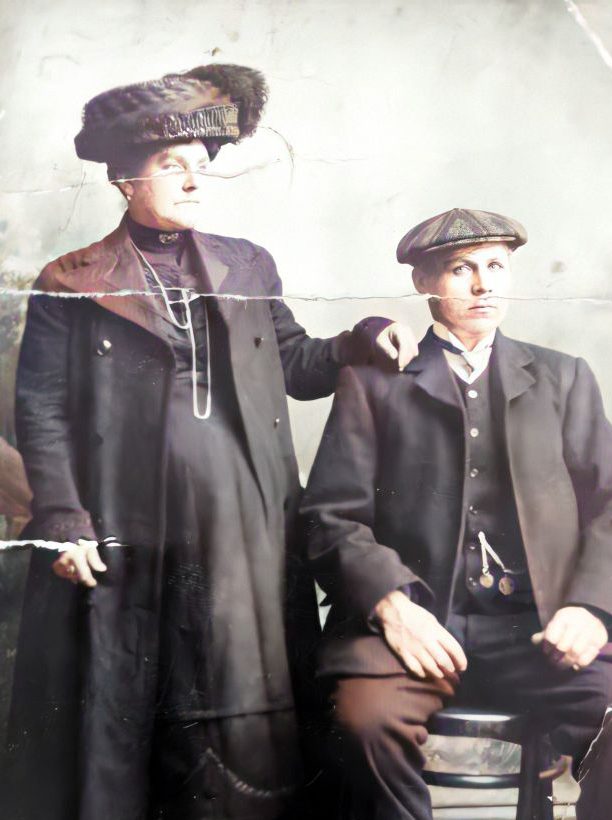
Mary Jane alongside a man likely to be Alfred

Sadly, Alfred’s father passed away on 26 August 1883, aged 62 years. His father’s loss represented his first significant loss, apart from the death of his Grandfather back in the 1860s. His father was buried in a public grave (10027) at York Cemetery in the afternoon at around 3:30 pm. Another loss followed in 1884 when his first son Edward was born. Unfortunately, he lived a mere five hours and died on 3 March 1885. I can’t be sure, but Edward may have been named after Alfred’s older brother, who he likely looked up to, perhaps making the loss sting that bit more.

The birth of his daughter Ada in 1886, ironically born on or around the same day as her brother Edward and then followed by the births of Albert Victor in 1888 and Florence Edith in 1890, cemented the end of his period of quite tragic loss. In 1891 the family lived in four rooms at 33 Duke of York Place in Walmgate. The birth of my Great Great Grandfather, Arthur Dale, followed in 1893 alongside the birth of the youngest child, George Alfred, in 1898. The family remained living at 33 Duke of York Place in 1901.

Map showing Duke of York Place

Things seemed to be looking up for Alfred. He had managed to replace a period of loss with the growth of his family. Things mightn’t have been easy, and fears for his job security might have started to bubble up towards the beginning of the 20th century, but regardless it is arguable he had managed to get through the worst and had a lot to look forward to in life.

Life is perhaps more cruel than we like to acknowledge, and this cruelness was seen when Alfred became ill with tongue cancer. He passed away aged only 47 years, at home, on 30 August 1906. He was buried at York Cemetery in a public grave, just like his father twenty three years earlier.

Alfred’s grave

In Alfred’s memory, a kerb was erected on the grave, but it has since sunken. It seems almost to be the direct words of Mary Jane: “In Loving Memory of my beloved husband Alfred Dale, who died 30 August 1906”. Of course, we cannot put words into the mouths of others, whether they are dead or alive, but I, at least, believe that this shows the deep affection and love between the couple and only adds to the tragedy of his unnecessary and plainly cruel death.

I genuinely believe that Alfred was the man that “missed out”. Not only did he miss seeing all of his children growing up, but he also missed any real chance to get to know his grandchildren or see much of the dramatic changes of the 20th century. Furthermore, his son, George Alfred, served during the First World War and made the ultimate sacrifice in the spring of 1918. Sure, to some, it may seem a blessing that he missed the pain of the loss, but he never knew that his youngest boy would be capable of such courage and selflessness in serving his country.

George Alfred Dale

And surely, after all the loss and hardships of his life, knowing that courage was his legacy would have only made everything worth it?

Remembrance to Me

Back about seven years ago, in 2014, Britain marked Remembrance Day alongside the centenary of the outbreak of the First World War. I was only nine years old, so I naturally don’t remember a great deal from this time period; however, I do have some strangely distinct memories. We had an assembly on Remembrance Day, and towards the end, a video was played. I can’t remember at all what this video said or was about apart from it being related to Rememberance, of course. Towards the end, many photos of fallen soldiers were shown, which profoundly affected nine-year-old me. I suppose this was down to the fact that I was presented with the fact that the millions who died years ago were all human with aims, dreams, fears and hopes. As a kid, I was a sensitive soul, and I have no shame in saying that I had teary eyes walking back to class.

I always took Remembrance Day seriously subsequently, but it was a while before anything of significance happened. I joined the Air Cadets in 2017 and, because of this, partook in Poppy Selling and also marched at the Cleckheaton Remembrance Day parade.

My genealogical research began in March 2020, just before the lockdown was announced, and I came across the story of my Great Great Great Uncle George Alfred Dale. I have told his story on a Hidden Branch blog post which can be found here, but I became deeply connected to George. I couldn’t for the life of me tell you why but I bought/searched anything to find out more about him. I was lucky enough to have a picture of him already uploaded onto Ancestry and, in the early months of 2021, found a second picture of him online. I suppose what attracted me to him was simply that he was the first soldier I had come across and the fact he made the ultimate sacrifice. Another reason is that I am, in a way, named after him as my Great Grandfather George Ronald Dale, who I am named after, was named after him.

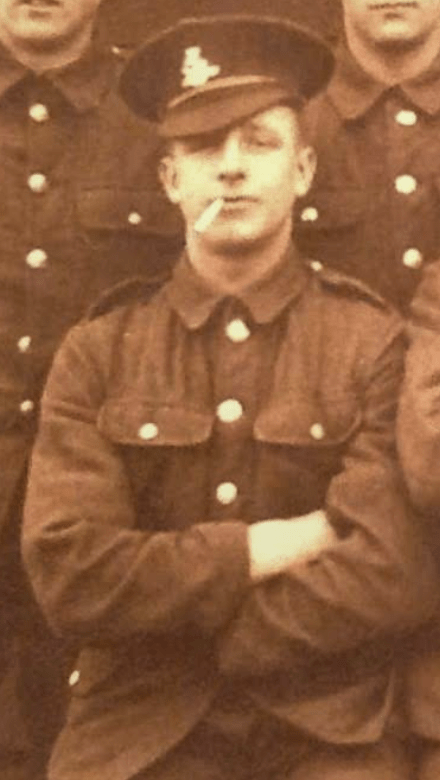
George Alfred Dale

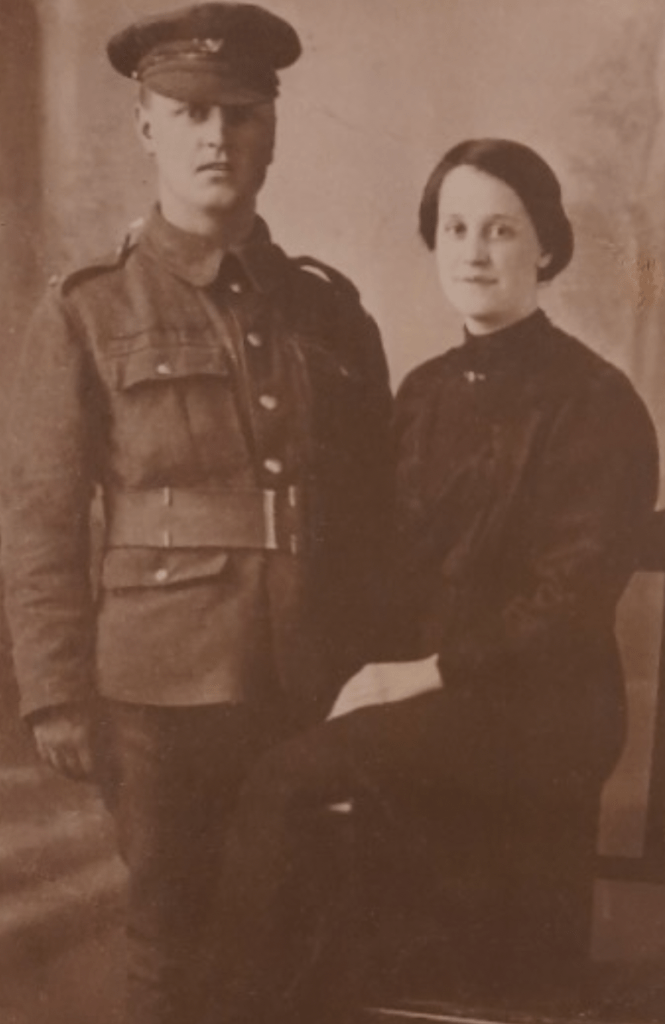
The next major story I uncovered was the service of my Great Great Grandfather Ernest James Hall. He was born in 1885 in Batley and had a rough childhood with a notorious alcoholic father. He married Emily Butcher in 1908, and the couple had seven children over their marriage. Ernest joined the 8th Battalion of the King’s Own Yorkshire Light Infantry at some point after the birth of his daughter Phyllis in 1915. He would have served across France but also Italy towards the end of the war. Quite a few of the Halls served in the First World War, including his nephew Walter and his brother Lewis with whom he appeared to enjoy a close relationship. Ernest was injured at some point in 1917 and suffered injuries to his sight, and was awarded a pension that lasted for about a year. He received the British War Medal, and Victory Medal, one of his medals was inherited by his son and my Great Grandfather Percy Hall. It remained displayed with pride by my Great Grandma even after my Great Grandfather’s death and is still in the family to this day. Ernest also sadly had PTSD, or as it was more commonly known at the time “shell shock” and kept himself to himself and rarely saw his grandchildren towards the end of his life.

Ernest in his army uniform alongside his wife Emily

Fred Hopkinson, another Great Great Grandfather, was born in 1896 in Birstall also served during the First World War. He joined the King’s Own Scottish Borders and served in a variety of different battalions and was sent to France in October 1915. In the summertime of 1916, he was injured, although the nature of the injury is unknown. He was awarded the British War Medal, Victory Medal and the 1914–15 Star. His experiences of the war were rarely mentioned, although my Great Grandmother Shirley, Fred’s only daughter, recounted that when he was in trenches, he was knee-deep in mud and water.

Fred Hopkinson in his uniform

My final connection is a larger project I have undertaken, researching and writing up the stories of all 36 known soldiers buried/commemorated at Liversedge Cemetery. The book will be published relatively soon (all will be announced on my website and social media), but it has been an experience writing it. The sacrifices, bravery and selflessness of the wartime generation bled through the individual acts of bravery and sacrifices to provide a model that everyone should strive to follow in the modern-day.

Remembrance Day means a lot more to me than it did before, and I hope that this can prove to you that there are many different ways to engage with remembrance. I haven’t even mentioned any of my Great Grandfathers that served during the Second World War or that of their siblings, both male and female, who contributed and made sacrifices to the war effort in their different ways. It is essential that we remember our fallen troops just as much as the ones who lived with the consequences of their service up until their passing. We must also ensure that in 100 years, Rememberance remains as significant as today and 100 years ago as if we forget, we are doomed to repeat.

The Brigantes and the Pre-Roman Spen Valley

According to local historian, Thomas William Thompson, the Spen Valley was once inhabited by a “brave, fearless people” who were “small in stature” but made up for that by their physical strength. They were known as the Brigantes and controlled the vast majority of Northern England in pre-Roman times.

Approximate territory of the Brigantes

The Geography of the Spen Valley would have been key to how these lived, and Thompson also gives us a captivating description of what the Spen Valley may have looked like in this pre-Roman era. The area of Spen was “densely wooded with beech, oak, pine and thorn trees” and “gorse, broom, and blackberry bushes” would reach the edge of the “broad stream of water” that would one day be known as the River Spen. This river itself twisted down the valley, collecting driftwood and other debris brought downstream by melting snow or stormwater. There were probably stretches of moorland, at places like Harsthead Moor, that were “covered with bracken, ling, gorse, broom, and blackberry bushes”.

Bee-hive shaped “wattle-and-daube” huts may have been built in this landscape. These huts were built by the Brigantes and were supported by a network of tree branches, interwoven with twigs, and covered with mud or clay. It was dark inside the huts, night or day, as there was only a small hole to enter or exit. One family resided in one hut, and they were all built close together, forming a small village that was protected by a fence or enclosure to keep out dangerous wild animals.

A typical wattle-and-daube hut

The Brigantes didn’t have any knowledge of metal, so, therefore, could only use tools made of bone, wood or stone. They typically used choppers and hammers for weapons, which were mainly used for defensive or hunting purposes.

Men would leave to go hunting in parties, typically killing wolves and bears, to secure their skins, which were then taken to the village to be preserved. Women would use these skins to create clothing for the village; they would use bone needles and strips of hide to sew the clothes together. Of course, the men would also hunt other animals for various other purposes, including to eat.

The people were likely self-sufficient, eating a diet of fish, deer and wild boar. They also collected nuts and succulent roots to be eaten in winter and during summer and autumn could rely on an abundance of wild fruits. The Brigantes could make fires, and these would be lit outside where they would cook communally, away from their huts to avoid setting them on fire.

There is not much known about the religion of the Brigantes, but they probably worshipped a goddess named Brigantia.

A statue depicting the goddess Brigantia

The Brigantes remained a dominant force across the North of England up until the Roman conquest and would take the Romans decades to subjugate. It is arguable that the distinct identity of Yorkshire and the unique genetic identity of West Yorkshire can be traced back to the Brigantes, to an extent.

Catherine Conley: A Life of Loss

Catherine Conley was born in the July quarter of 1873 in Monkwearmouth, Sunderland in County Durham. She was the eldest daughter of James Conley, a coal miner, and Bridget Cook. Bridget had another child from a previous marriage named Charles McIlroy, but her husband sadly passed away around the time of his birth. Bridget’s loss caused Catherine’s life in many ways and loss was to follow her for the rest of her transient life.

Baptisms and burials were the main events for the Conley family over the next few years. George Conley, born 1875, survived infancy but the next brother, James, died aged only one in 1878. Peter was born in 1879 and managed to survive infancy. The family resided in cramped conditions, at 38 Brooke Street, in 1881, with the house holding two families totalling eighteen people.

John Street, Monkwearmouth (where the Conley family lived during the 1870s) circa 1850. Courtesy of Brian Dunn.

The new decade that the 1880s brought seemed to stop the relentless losses for the Conley family. Mary Ann, the second daughter of James and Bridget, was born in 1882, followed by the birth of John in 1885. Another daughter called Julia was born two years after John in 1887. Sadly, this happiness was a cruel mirage because death creeped around the corner.

Tuberculosis was the killer.

The silent plague that swept the slums killed Bridget, aged only 42 years, on 13 January 1891 just shortly after the birth of her daughter Martha Conley. Martha would survive for about 2 months before dying in March 1891. A small snapshot can be seen of the family after these two losses on the 1891 census which was taken a mere 26 days after the death of Martha. James resides with his children at 18 Stobart in Monkwearmouth and continues to work as a Coal Miner. Catherine’s responsibilities would have skyrocketed after her mother’s premature death as she was the eldest child. It Is likely she would have filled a large portion of the domestic work Bridget used to complete.

Death Certificate of Bridget Conley

More deaths occurred in the shattered remains of the Conley family during the early 1890s. John Conley died aged 7 years in 1892 and was followed to the grave by his sister Mary Ann, in 1894, aged 12 years. James and Bridget had eight kids in total; half of them died in their childhoods. Catherine was only twenty years old and had seen the death of her mother and all these siblings. More was to follow.

Catherine married John William Jobling in the first quarter of 1895, aged 21 years. They probably got married at the local catholic church or registration office. Their first child was a girl who was born in January at home. She was named Bridget, most likely after her maternal grandmother Bridget Cook, and like her grandmother would suffer a premature death, at the age of two years, in 1898. The couple had moved to 1 Back Dundas Street, not that far from James Conley, by the burial of their daughter Bridget on 17 Aug 1898.

The death notice of John Jobling in the Sunderland Echo

Possibly the worst of Catherine’s losses was to follow with death of her husband, John Jobling. 21 May 1899 was an unremarkable day for the Jobling’s, apart from the fact that John got a piece of broken glass from a vase stuck in his heel. He did not bother about it much until he fetched a doctor on 29 May 1899 to treat him. Despite their best efforts, it was all in vain, and Jobling perished on 6 June 1899 at roughly half past seven in the evening.  

Tragically, Catherine was pregnant when John died. She gave birth to a boy in mid July 1899 at home which would be named John, presumably after his late father. 6 weeks was all it took for John to join his father and sister in death.

Catherine was abruptly alone.

She seems to disappear after the death of her son John Jobling, as she is not present on the 1901 census as far as I have searched. It is likely she stayed local though as she moves to Whitburn Street by 1904.

Catherine married Luke McGinty, a 44-year-old widower, on 12 July 1905. He had an equally as tragic background and lost all but one of his ten kids to his first wife Sarah Hannon. The couple moved into 20 Whitburn Street by 1906 where my Great Grandfather James “Jim” McGinty was born on 14 November of that year.

Jim McGinty (Catherine’s son) in later life

Catherine was only 34 years old when Tuberculosis prised her from her family on 28 February 1909. My Great Grandfather had barely turned two years old when he lost his mother. She was buried at Mere Knolls Cemetery, like the rest of the family, on 3 Mar 1909.

My grandma did not even know her grandmother’s name until 2017. Her story remained a mystery even after that as the records were unclear and conflicting for a long time. Once her story was discovered, it was apparent it was clearly one of loss. Not just merely loss of life but a much deeper loss; a loss of memories, a place in history and the loss of being a mother.

Catherine’s courageous story will be remembered now as it should have been years ago.